
FNA board appoints Melissa Charlie
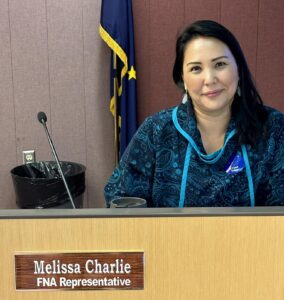
Fairbanks, Alaska–Melissa Charlie sees the FNA advisory seat on the Fairbanks North Star Borough School Board as a place where people will hear the voice of Alaska Native students.
“Now our Native kids have representation advocating for higher graduation rates, transportation, special education, nutrition, testing, and anything else that our students need to be successful,” said Charlie, FNA executive director and school board advisory member.
“Also, I think it’s important to note how important our culture and traditional values are to us and now we are bringing that to the school board level. It’s been long overdue.”
Last summer the FNSB school board unanimously approved providing an advisory seat to FNA and the FNA board appointed Charlie to fill the seat. While Charlie doesn’t have a vote, she is able to speak on matters before the board and bring up other issues. She sits on the school board’s Budget Committee.
The school budget, literacy rates, and dropout rates are at the top of Charlie’s concerns.
The upcoming school budget deficit is the largest issue facing the school district, Charlie said. The deficit for the 2025-26 school year is estimated to be $16-32 million, and could result in up to five elementary school closures, layoffs, and larger class sizes. This deficit is more serious than it has been with previous school closures.
“The consolidation of schools will have a negative impact on our students,” she said. “Our classrooms will grow bigger, and those students who need help the most may not get proper interventions.”
The Alaska Reads Act, which requires students learn to read by third grade, is another issue. If a student has not achieved reading profiency for their grade level, they may be held back. Furthermore, the Alaska state legislature did not provide funding to provide extra help to those students who need it, she said.
“Kids are not going to learn to read at the same time,” Charlie said. “Interventions for kids are outside of school hours. Some families don’t have transportation and are not able to get to the limited services the schools do provide.”
Charlie is also focusing on the Alaska Native dropout rate, which was 6.9% according to the latest figures. In order to bring those rates down, the school district has to address issues early in a student’s academic career that could later cause them to drop out before graduation.
“I’m familiar with statistics and data, which makes the full board more aware of where I’m coming from,” she said.
Education was one of the issues facing Alaska Natives when FNA formed in 1963. Back then Native students were sent to boarding schools, Charlie noted. Soon after FNA started the Johnson O’Malley Program and then later brought in the federal Head Start program to address education. Both programs are still operating.
Also, in addition to Charlie’s position, FNA staff are on school board subcommittees. Joshua Peter, FNA IT director, is on the Curriculum Committee and the Legislative Committee. Mary Willey, FNA Johnson O’Malley and Tribal Home Visiting director, is on the Board Policy Committee. Cecelia Hudson, FNA JOM, is on the Family Engagement Committee, and Rebekah Jackson, FNA JOM, is on the Diversity Committee.
Parents can help their students, too, Charlie said.
“Their children’s education is so important that we can’t just rely on the school district,” she said. “Read to them. Make sure they are fed and rested to be ready to learn and be challenged. Love them and nurture them so they can succeed.”
Finally, Charlie’s message to students is to not give up.
“You are smart and capable and have the ability to do and be whoever you want,” she said. “Be proud of who you are and where you came from.”